What is Brain Rot? – The impact of excessive use of digital media on cognitive functions
Brain rot - a phenomenon of degradation of attention and cognitive functions caused by excessive use of digital media, which becomes a serious social, technological and design challenge.

„Brain rot” is a colloquial term used to describe the negative effects of excessive use of digital media, especially low-quality content available on social media. Although this term is not a medical term (at least for now), more and more scientific research indicates real threats to mental health and cognitive functions related to excessive use of digital content.
Effects of excessive use of digital media
Excessive use of social media has a real, empirically proven impact on the cognitive functioning and mental health of users, especially among children and young adults. A study conducted by Farchakha and colleagues (2022) on a sample of adult residents of Lebanon found a strong association between problematic social media use and the severity of attention deficit hyperactivity disorder (ADHD) symptoms. The analysis showed that people who used social media more often showed significantly higher scores on scales measuring impulsivity and difficulty concentrating. Moreover, emotional anxiety was shown to mediate this relationship, meaning that more anxious people were also more susceptible to ADHD symptoms resulting from excessive exposure to social media (Farchakh et al., 2022).
The second significant study, conducted by Ra and co-authors (2023) in South Korea on a sample of 1,209 children aged 7–10, analyzed the impact of exposure to digital media on executive functions, taking into account the level of intelligence. Researchers found that children who consumed heavy media (mainly video content) had markedly impaired abilities in working memory, attention control, and action planning, especially if their IQ was equal to or lower than 100. This indicates that media exposure may exacerbate differences in children’s cognitive functioning depending on their cognitive resources (Ra et al., 2023). Both studies confirm that the consequences of intense presence in digital media are not just subjective observations, but have a strong empirical basis and should be taken into account both in the context of education and mental health prevention.
Neurobiological mechanisms
The impact of excessive use of digital media on the brain also has a neurobiological dimension. Regular stimulation of the reward system through fast, variable content – such as short films or notifications – leads to overactivation of the dopaminergic pathway, especially in the nucleus accumbens, which results in the consolidation of compulsive habits. Neuroimaging studies have shown that heavy social media users show reduced gray matter volume in areas of the brain responsible for impulse control and action planning, such as the prefrontal cortex. At the same time, weakening of neural connections within the white matter is observed, which may affect the speed and quality of information processing.
These mechanisms are particularly disturbing in the case of children and adolescents, whose frontal cortex is still developing and the brain is more plastic and susceptible to permanent changes. Excessive dopamine activity may result not only in difficulty in concentration and impulse control, but also in behavioral addiction, comparable to addiction to psychoactive substances. Moreover, chronic overstimulation may disrupt natural biological rhythms, such as sleep, which indirectly affects the processes of memory consolidation and regeneration of the nervous system.
Declining ability to concentrate: 12 to 8 seconds
In the last two decades, the average human attention span has decreased significantly. According to data published by the Golden Steps ABA, the average attention span in 2000 was around 12 seconds, while in 2023 it has dropped to just 8.25 seconds (Golden Steps ABA, 2023). For comparison, it is commonly said that a goldfish can maintain attention for about 9 seconds. Even more disturbing data is presented by digital attention researcher, prof. Gloria Mark from the University of California, Irvine. Its longitudinal research has shown that the average time a user spends on a single screen task has fallen from 2.5 minutes in 2004 to just 47 seconds in 2023 (Mark, 2023).
Data consumption explosion: from megabytes to zettabytes
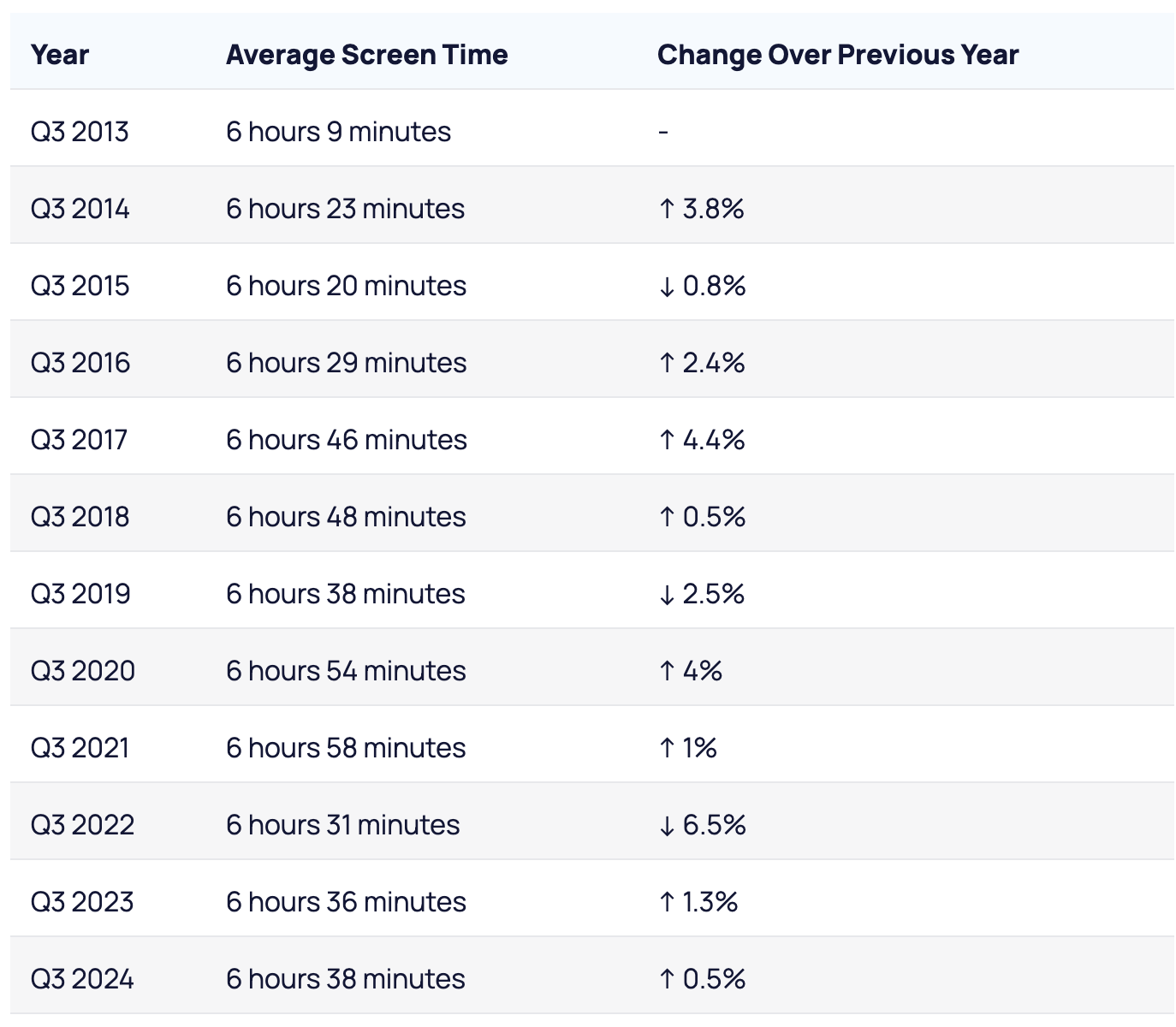
The rate at which we consume information has also increased exponentially. According to data collected by the Exploding Topics website, in 2010 the global amount of data generated annually was approximately 2 zettabytes. In 2024, this number has already increased to over 147 zettabytes (Exploding Topics, 2024). The vast majority of this content is video – data estimates that over 60% of all global data transfer comes from multimedia content. Additionally, the average internet user currently spends on average6 hours and 38 minutes (SIC!) a day spent using connected devices(Exploding Topics, 2024).
Summary: technology that is beyond us
The phenomenon of „brain rot” is not just a linguistic internet meme, but an increasingly real social problem, the source of which are well-thought-out but mindlessly duplicated digital design mechanisms. Today we are dealing with generations growing up in an environment that constantly competes for their attention, reducing their ability to concentrate, undermining mental health and transforming the basic mechanisms of how the brain works. Research shows that this transformation is not just superficial – it affects the neurological structure, disrupts sleep, concentration and even cognitive development in children. At the same time, we consume thousands of times more data than two decades ago, and our attention is fragmented into microscopic segments, adapted to the format of reels, shorts and push notifications.
For UX/UI designers, marketing strategists and digital product owners, this is the moment when the long-term consequences of digital design can no longer be ignored. If we don’t redefine what „success” is in the world of apps, platforms and online experiences – if we continue to reward only screen time and engagement – then we are collectively designing an environment that disempowers rather than empowers the user. Ethical design, digital hygiene, personalization without manipulation, breaks for regeneration and supporting deep concentration – these are no longer „nice to have”, but a real responsibility of everyone who shapes the digital landscape.
It’s not about demonizing technology – it’s about understanding its real impact and consciously shaping its development. Otherwise, „brain rot” will go from being a catchy meme to becoming a label for the entire digital age.