Aversion to changes in product design – how to guide the user through an emotional rollercoaster
Changes to user interfaces trigger emotional resistance not because they are bad, but because they disrupt established cognitive patterns and sense of control - and acceptance of them is always a process, not a point.

Changes in digital products – new features, redesign, interface changes – are inevitable. For companies it is a step forward, for users… often a source of frustration. Even the best-designed change can cause anxiety and resistance. Why is this happening? The answer lies in the phenomenonchange aversion– the user’s natural, emotional reaction to new products.
Emotion curve – what does the graph show?
The visualization of the user’s emotional cycle, created by Saee Vaze, shows how users’ reactions changebefore, during and after introducing the change. The graph shows the „trough of change” – the moment when the user’s emotions drop to the lowest point.
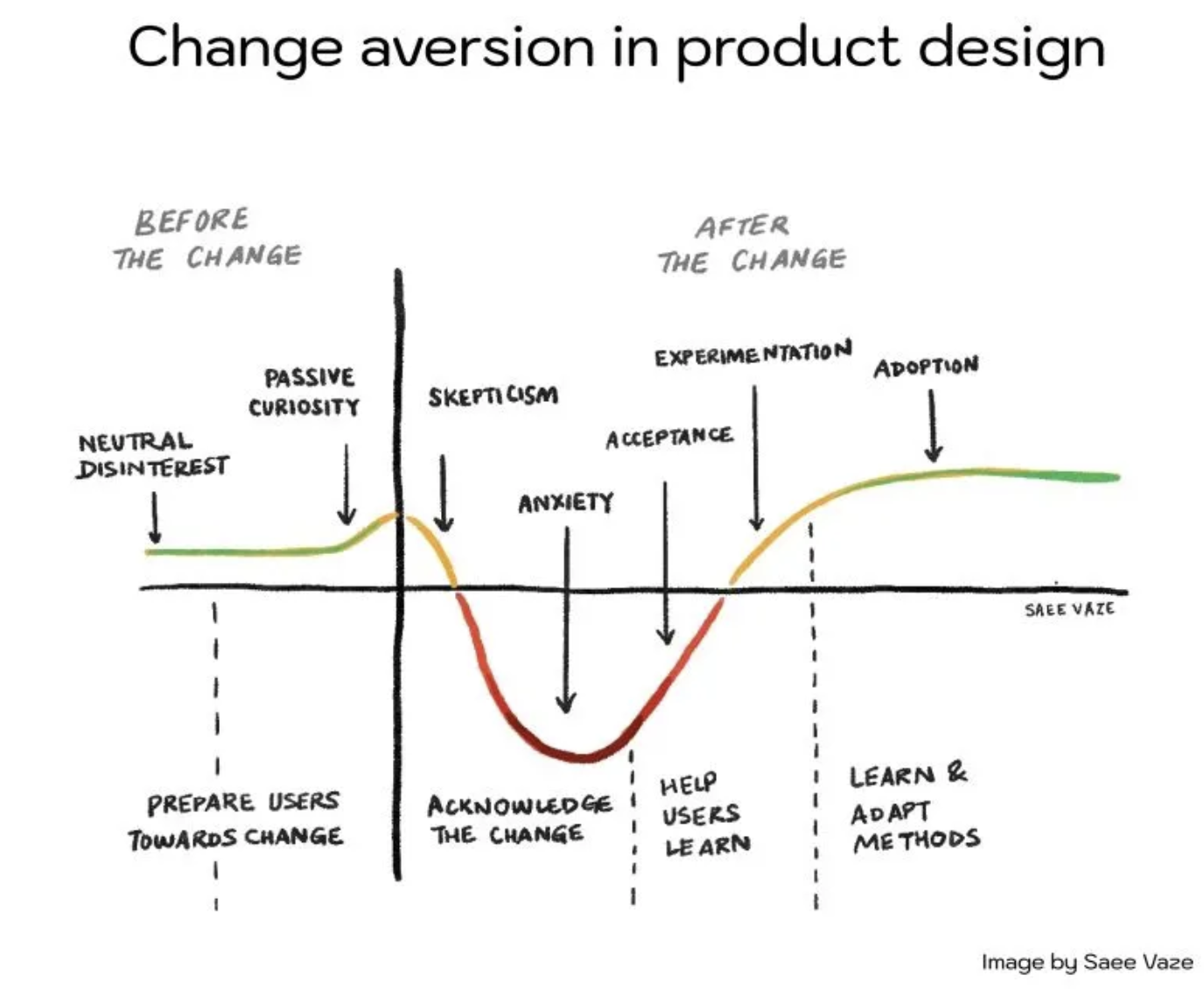
User response steps:
- Neutral disinterest
Before the change occurs, users operate in a familiar environment. They don’t expect a revolution. - Passive curiosity
Over time, signals about the upcoming change begin to arrive. Curiosity is born, but also vigilance. - Skepticism and anxiety
After implementing a change, there is natural resistance – users may feel lost, frustrated, and sometimes disappointed. - Acceptance and experimentation
After some time, the user begins to explore new things. He checks how it works, what has changed and whether it was really worth it. - Adoption
Ultimately – if the change has been well designed and communicated – the user accepts it as the „new normal”.
Why do people resist change?
Resistance to change is a common psychological phenomenon, regardless of whether it concerns personal, social or organizational life. Although changes may bring objective benefits, many people react negatively to them. From the point of view of psychology, this is not an expression of irrationality, but the result of deeply rooted cognitive, emotional and social mechanisms.
One of the first and most famous explanations for resistance to change is the theory of cognitive dissonanceLeon Festinger. This theory posits that when an individual experiences inconsistency between beliefs and new information or actions, psychological discomfort arises. To get rid of it, peoplethey often reject new information, minimize their meaning or change beliefs to restore internal consistency (Festinger 1957).
The phenomenon of loss aversion, described in the prospect theory by Daniel Kahneman and Amos Tversky, also plays an important role. These researchers showed thatpeople feel a loss more strongly than a gain of the same value,which means that change – even potentially beneficial – may be interpreted as a risk of losing something familiar and stable (Kahneman and Tversky 1979).
Another factor influencing resistance is the so-calledstatus quo bias— the tendency to prefer the current state of affairs. This phenomenon means that people often stick with familiar solutions even when available alternatives are better, because new options involve cognitive effort and risk (Samuelson and Zeckhauser 1988).
In the social context, it is worth recalling the theory of system justification developed by John T. Jost. According to her, individuals tend to legitimize and defend the existing social order – even if it is unjust or ineffective. The need for order and predictability leads to people often subconsciously sabotaging or weakening changes that could disrupt the status quo (Jost 2020).
The last important element is the phenomenonpsychological inertia, i.e. the tendency to maintain known habits and patterns of action. Change requires cognitive and often emotional effort – you need to abandon old patterns, learn new ones and adapt to the new situation. In cognitive psychology, this resistance is sometimes treated as a natural reaction to the need to reorganize the cognitive system (Oreg 2003).
For these reasons, change – although rationally justified – can be psychologically difficult to accept. However, understanding these mechanisms allows you to better manage transformations, implement them with greater empathy and effectiveness, as well as minimize the fear and resistance they may cause in people involved in the process.
The psychology of change in user interfaces
User interface changes – such as redesigning navigation, changing icons, reorganizing features, or introducing new ways of interacting – rarely go unnoticed by your audience. On the contrary: they often become a source of violent emotions and opposition, even if they are the result of many months of research and are intended to improve the overall user experience. Resistance to UI changes not only fits into the classic psychological mechanisms mentioned earlier, but also has its own specificity resulting from the nature of human interaction with technology.
From a psychological perspective, changes in the interface touch upon deeply rooted cognitive patterns. An interface that a user has learned over months or years becomes not just a tool, but an extension of their own way of doing things. Changing a tool requires not only learning something new, but also disintegrating a previously developed pattern (Norman 2013). This need for cognitive reorganization triggers a typical emotional response, perfectly illustrated in the „Change Aversion in Product Design” chart – ranging from neutrality and curiosity, through anxiety and skepticism, to acceptance and adoption.
The moment of greatest resistance – the so-called “trough of change” – this is a critical stage that may determine the success or failure of the redesign. At this point, users often feel that they have „lost control”, that the system has become „unintuitive”, or that their existing skills have lost their value. Psychologically, this reflects the fear of losing competence, which in the literature is referred to as a threat to self-efficacy (Bandura 1997).
In turn, after the disorientation phase, provided that the interface is consistent, logical and well supported by onboarding, users move to the exploration stage. This is the moment when previous resistance gives way to curiosity and testing new possibilities. Users are starting to adapt to the changes, although they may still evaluate them compared to the „old version”. Only after this stage can the so-called adoption, i.e. accepting the new standard as natural.
It is worth emphasizing that the user’s emotional path is not just a theoretical pattern. Research shows that strong reactions to changes in the UI can affect not only user satisfaction but also user retention (Oulasvirta and Hornbæk 2016). Therefore, the key task of the designer is not to „avoid” resistance, but to take it into account: through empathetic messages, feature toggles, phased implementation or appropriate cognitive support (tutorials, tooltips, micro-interactions).
Knowledge of the psychology of change allows not only to design better interfaces, but also to introduce changes more wisely – in a way that does not cause shock, but guides the user through emotional adaptation to full adoption.
Summary
The change in the UI is not just a technical update butintervention in the user’s cognitive habits and emotional comfort. Any redesign, even one based on data and best UX practices, may be perceived as a threat – to the sense of control, effectiveness and stability. These types of reactions are consistent with well-established psychological knowledge, including: cognitive dissonance, loss aversion, status quo effect or system justification theory.
The key task of the designer and the product team is not to „run away” from resistance, butconsciously designing the transition process– from skepticism to acceptance. Techniques such as change announcements, switchable functionalities (toggle UI), soft onboarding, educational support and real-time user research are helpful here.
Understanding the emotional change curve – such as the one shown in the “Change Aversion in Product Design” chart – allowsplan changes not as a point, but as a process, which takes into account the user’s cognitive and emotional needs. Only then can change be welcomed with curiosity instead of resistance – and the new interface become not an obstacle but a value.
Sources:
- Jost, John T. 2020.A Theory of System Justification. Cambridge, MA: Harvard University Press.American Psychological Association+5Academia+5UW Courses+5
- Kahneman, Daniel, and Amos Tversky. 1979. “Prospect Theory: An Analysis of Decision under Risk.”Econometrica47(2): 263–291.
- Norman, Donald A. 2013.The Design of Everyday Things. Revised and Expanded Edition. New York: Basic Books.
- Oreg, Shaul. 2003. “Resistance to Change: Developing an Individual Differences Measure.”Journal of Applied Psychology88(4): 680–693.ResearchGate
- Oulasvirta, Antti, and Kasper Hornbæk. 2016. “HCI Research as Problem-Solving.” InProceedings of the 2016 CHI Conference on Human Factors in Computing Systems, 4956–4967. New York: ACM.Aalto University’s research portal+1ACM Digital Library+1