NPS, CSAT and CES metrics
The importance of using metrics to assess organizational performance and track progress over time. You will read about CSAT, NPS and CES - explaining their differences, similarities and effective ways of measuring.

Introduction to metrics
MetricsCES (customer effort score),CSAT (customer satisfaction score)andNPS (net promoter score)– these are the tools that organizations use to assess their performance, locate areas for improvement, and track their progress over time. They are used in various areas of life, from sales and marketing, through customer service, to product development. It’s like a combination of a power meter and a thermometer that helps us understand how well our organization is performing and, above all, what actions should be taken to increase its efficiency by increasingcustomer satisfaction. Metrics can be extremely helpful for any organization – from small start-ups to large multinational companies.
Tracking key performance indicators (KPIs) helps organizations identify areas where they excel as well as those where they need to improve further.
By leveraging data, organizations make decisionssmarter decisions, which in turn leads toincreasing efficiencyandbetter business results.It’s like having your own personal detective who finds weak spots and helps improve your organization. And if you have your own detective in your organization, you don’t have to worry that someone else will do it for you.

Why use metrics?
Apply metrics and you’ll see your organization run like a well-oiled machine. Metrics help you understandwhat works and what doesn’t, and what you need to do to achieve success. Imagine that you have superpowers that allow you to see the future and predict what will happen to your company. While metrics aren’t as powerful, they do get you closer to identifying quickly enough which areas need improvement. It may be the customer service department, product quality, or even something as prosaic as a broken button on a website that causes huge irritation and an outflow of users to the competition. A small digression – when it comes to mobile applications or websites, it may be a good solutionUX audit, which, even before observing user problems in the form of surveys, can be noticed by User Experience experts and eliminated.
Coming back to metrics, don’t be afraid to use metrics, even if you are a small startup. They are equally useful for every organization, from small companies to large corporations. Remember that metrics are not just numbers – they are the voice of your customers and users, which provides free feedback on what to improve to increase satisfaction and, therefore, the likelihood of continuing to use the service or make a purchase.
Who should use metrics?
It doesn’t matter whether you run a small company or a large corporation, metrics are for everyone. They are particularly useful for entrepreneurs and teams who want to track their progress over time, identify areas for improvement, or evaluate the effectiveness of specific initiatives.
If you run an online store, metrics will help you understandwhat products are most popular,and which ones require improvement. Thanks to them, it will be easier for you to identify your customers’ behavioral patterns and adapt your marketing strategy to their needs.
If you are a manager, metrics will help you understandhow well your team worksł and where improvement is needed. Thanks to them, you will be able to assess the performance of individual employees and adapt tasks to their skills.
If you are an entrepreneur, metrics will help you understandhow your company growsandwhat you should focus onto achieve success. Thanks to them, you will be able to make smarter decisions and increase the effectiveness of your organization.
In short, anyone who wants to be effective and achieve better business results should use metrics. It’s a tool that allows you to understand what works, what doesn’t, and what you need to do to be successful.
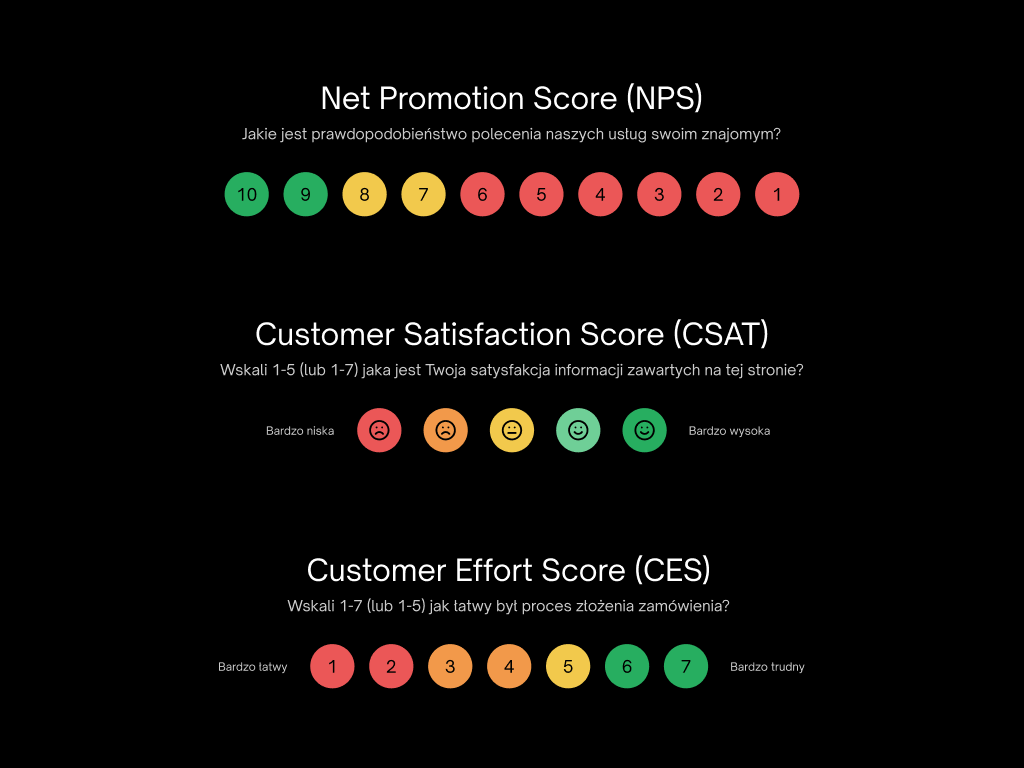
3key metrics: CSAT vs NPS vs CES – what do they measure?
CSAT,NPSandCESare three metrics that help us understand what customers think about our products and services.
CSATmeasures how satisfied customers are with a product or service, aNPSmeasures how loyal our customers are and how willing they are to recommend our products to others.CESmeasures how easy or difficult it is for customers to use our products and services.
But let’s be honest, you don’t have to be a SpaceX scientist to understand these metrics. Let’s say you know that your grandma likes her new sofa. That’s itCSAT. But what if your grandma not only loves her new sofa, but also wants all her friends to buy it? ThisNPS. What if your grandma can’t adjust the headrest of her new coffee table? That’s itCES.
So, if you want to know what customers think about your products and services, use these three metrics. But remember thatit’s not just numbers – it’s people, who decide whether your business is worth the effort. So take care of your customers and they will take care of you.
CSAT vs NPS vs CES: Differences, similarities, how to measure?
Although all three metrics measure customer satisfaction, they differ in what they measure and how they are measured. CSAT measures overall satisfaction with a product or service, while NPS measures loyalty and willingness to recommend. CES measures how easy or difficult it is to use a product or service. All three metrics are typically measured through surveys, with questions designed to collect relevant information.
| Metric name | Description | What does it measure? | Scale | Example |
|---|---|---|---|---|
| CSAT | Customer Satisfaction Score – a measure of user/customer satisfaction | Satisfaction with a given product or service | Scale from 1 to 5 or 1 to 10 | On a scale of 1-5, how satisfied are you with the content on this website? 1 = very dissatisfied 5 = very satisfied |
| NPS | Net Promoter Score – a measure of customer loyalty | Loyalty and willingness to recommend a product or service to others | Scale 1-10 | On a scale of 1-10, to what extent would you recommend our services to your friends? |
| CES | Customer Effort Score – a measure of the ease of performing specific tasks, e.g. making a purchase in a store | Difficulty or ease of using a product or service | Scale from 1 to 5 or 1 to 7 | Soup at the store was easy for me: 1 = very difficult 5 or 7 = very easy |
Sources:
- https://www.qualtrics.com/
- https://www.hotjar.com/blog/
- Reichheld, F. F. (2003). The one number you need to grow. Harvard business review, 81(12), 46-54.
- Keiningham, T. L., Cooil, B., Andreassen, T. W., Aksoy, L., & Hsu, M. (2007). A longitudinal examination of net promoter and company revenue growth. Journal of marketing, 71(3), 39-51.